Interaktive Medienstationen
Visitor Center
Technisches Konzept und Umsetzung von 32 interaktiven Stationen für das neue Besucherzentrum einer internationalen Organisation mit Sitz in Österreich.
Planning, development, and implementation of 32 multimedia interactive stations for the visitor center of an international organization. The project includes touchscreen installations, interactive test stations with object recognition, as well as multi-screen setups with life-size 75″ explainer videos that can be controlled via touch interfaces.
In addition, physical input devices, microelectronics components, and LED control systems were integrated.
Our tasks included the technical concept and system architecture, hardware and application development, as well as the creation of a content management system. Furthermore, we were responsible for hardware procurement, system integration, and on-site installation, as well as operating system and kiosk configuration for stable continuous operation in an exhibition environment.

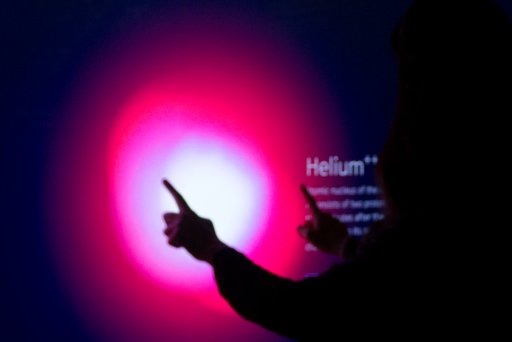
Broad variety of interactive exhibition installations showcasing the organisation's fields of work.

“Mock” XRF-Gun where our custom trained AI image recognition model recognizes objects to display the real world measurement data obtained with this type of instrument.
The device contains a Raspberry PI with a camera running the recognition model, sending data to a secondary PC controlling the main touchscreen. The animated analysis data and supportive description can than be read.


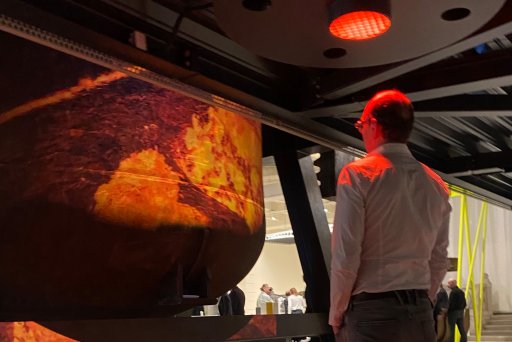
Multiscreen setup, interactive hands-on object with thermal imaging, where visitors can take a thermal selfie.

Interactive timeline - the touchscreen tablet can be moved along the timeline and displays supportive audio-visual media slideshows for the 45 milestones of the timeline.
The touchscreen application communicates with a Raspberry PI which recognizes the current position to load the correct content on demand.
Custom 3D rendered coral reef animation displaying the effects of ocean acidification. Visitors can experience the effects of global warming by controlling the installation with a physical slider.
The effects of different levels of temperature change are then displayed by the adaptive 3D rendering showcasing coral bleaching and the effects on the survival of different fish populations.

“Mock” test device, where users can find out about water samples and the methodology of tracing pollution to it's source.
Samples are recognized by a RFID reader connected to a Arduino microcontroller. Our custom soldered LED components are then dynamically controlled to first display the sample source - lighting up on the illustration. After the user pushes a physical test button, the pollution origin is lighting up and in depth explanatory content can be explored on the test device's touchscreen.
Challenges 🥵
Project management complexity: The development and implementation of the interactive stations required close coordination between multiple stakeholders, including exhibition designers, curators, architects, hardware suppliers, electricians, network specialists, and software developers. Each installation combined custom hardware, electronics, software, and physical exhibition design elements, often with dependencies across different contractors and delivery timelines. Managing parallel development of 32 stations, hardware procurement, content acquisition, installation schedules, and on-site integration required detailed planning, iterative testing phases, and continuous communication between all involved disciplines to ensure that the final systems could be delivered and commissioned reliably within the exhibition timeline.
Heterogeneous hardware fleet: Mixing 32 full PCs with Raspberry Pi–supported extended functionalities required consistent deployment, performance tuning, and lifecycle management across different CPU/GPU capabilities and I/O constraints.
Exhibition-grade reliability: Interactive stations must survive continuous daily use. That means watchdogs, auto-recovery, robust kiosk lockdown, safe power-cycling behavior, and “no operator needed” restart paths. A monitoring system automatically sends out alerts when issues are detected, allowing rapid intervention or automated recovery.
Multi-device synchronization: Multi-screen and multi-component stations (screen + LEDs + buttons + sensors) required deterministic state handling so all elements remain synchronized even with intermittent connectivity or delayed network responses.
Physical + digital integration: Object recognition, physical buttons, microcontroller-driven LEDs, and touch interfaces had to behave as a single coherent interaction system. This required careful signal handling (debouncing, timing control, feedback loops) and robust fail-safe logic so installations remain functional even if individual hardware components temporarily fail.
Orientation & UX consistency: Touchscreens in portrait and landscape orientations (including rotated installations) required careful handling of UI layout, touch calibration, kiosk window management, and hardware acceleration differences across devices.
Content operations: A custom content management system allows curators and editors to update texts, media assets, and application states without disrupting running installations. Versioning, preview environments, and controlled deployment workflows ensure that updates can be tested before being rolled out to the exhibition systems.
Software complexity: The system integrates a wide range of software layers and programming environments—from low-level C firmware for microcontrollers, to Python services for device integration and hardware control, to Node.js backends and React-based interactive frontend applications. Linux system services coordinate application lifecycles, networking, and device drivers, while real-time communication between components is handled via WebSockets and lightweight service APIs.
Network complexity at scale: A dedicated exhibition network connects all stations, servers, and microcontroller components. The infrastructure combines distributed wireless access points configured as a resilient internal network segment for the exhibition systems. Careful IP addressing, service discovery, and traffic segmentation were necessary to ensure reliable low-latency communication between stations. Real-time communication between stations and services relied on WebSocket-based messaging and lightweight device protocols.
Deployment and system management: With dozens of stations distributed across the exhibition space, automated provisioning and configuration management were essential. Infrastructure automation tools such as Ansible were used to standardize operating system setup, deploy application updates, configure services, and maintain consistent configurations across all devices.
Verwandte Projekte